You Can Own That Stage Too
Watching From the AudienceFor a long time, I watched other people on the stage – confident, established, owning their sh*t

What used to feel straightforward, how people searched, clicked, and made decisions online, now feels fragmented, unpredictable, and sometimes completely opaque.
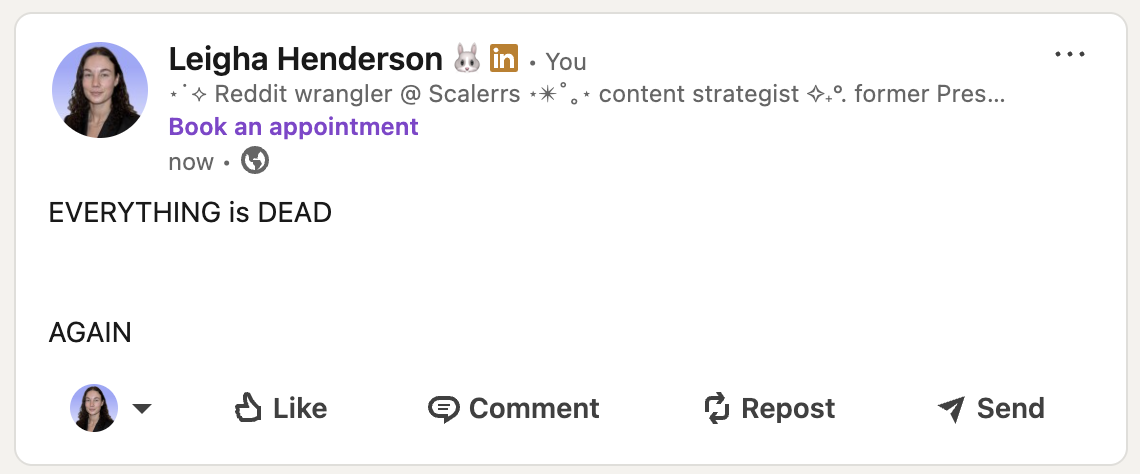
So we default to a simpler explanation: We say things are “dead.”
SEO is dead, blogging is dead, search engines are dead, clicks are dead, websites are dead. It’s part prediction/part performance/part coping mechanism for people who can feel the ground shifting under them but can’t quite explain why.
And yet, every time, nothing actually disappears.
The internet has never gotten rid of anything. Things have just gotten buried and harder to understand.
The internet absorbs, reshapes, and quietly reassigns roles in its ecosystem. What people interpret as “dead” is almost always just a loss of control. The old way of doing something stops working as predictably, and instead of adapting, we declare the entire channel obsolete and move on to the next thing we can pretend to understand.
Search is a perfect example. Whether it’s a traditional engine or an AI interface built by companies like OpenAI or Google, the core interaction is identical: a human asks a question and expects a useful answer. The interface changes, the formatting changes, the delivery gets faster, but the intent is consistent.
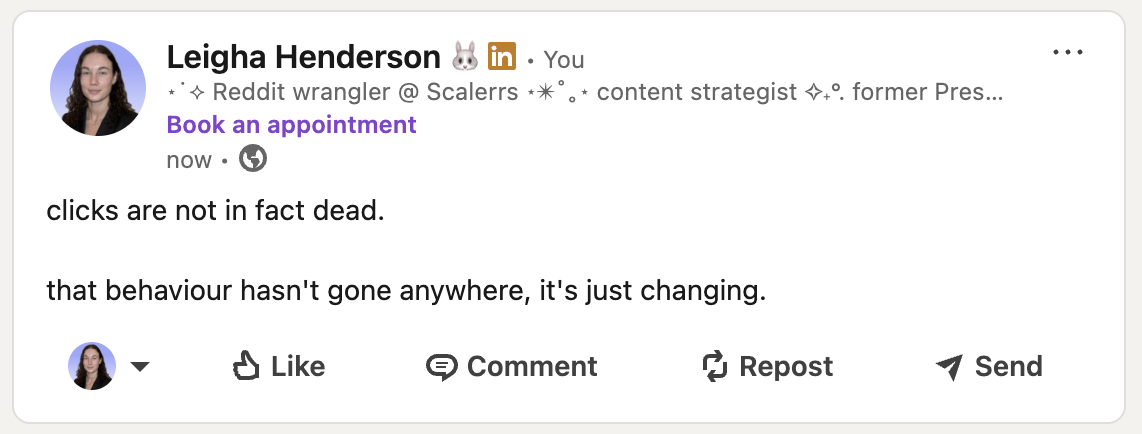
Human behaviour is changing, though. The behaviour of how people navigate, evaluate, and trust information online.
The marketers who understand this constant change don’t panic every time a new acronym drops (GEO, AEO, AIEO, AAO) or a platform update disrupts performance. They ask a much better question:
How are people finding information right now?
That question is annoyingly simple, and also the only one that holds up over time.
Right now, discovery is fragmented in a way that feels almost chaotic if you’re used to thinking in channels. It doesn’t live neatly inside a search engine results page anymore. It spills across platforms, formats, and contexts.
People are still Googling, but they’re also scanning Reddit threads, watching YouTube breakdowns, reading LinkedIn posts, and asking for recommendations in group chats that no marketer will ever have access to.
A single decision (what software to buy, what product to trust, what brand to believe) might involve five or six different touchpoints across entirely different environments. You can see this reflected directly in search results, where brand pages appear alongside review sites, which in turn appear alongside videos, which in turn appear alongside forum discussions.
At the same time, the volume of content being produced has reached a point where “a lot” doesn’t even begin to cover it. What once required time, effort, and some level of actual expertise can now be generated by AI in minutes, at scale, by anyone with a prompt and a deadline.
The result is an overwhelmingly dense internet.
Every topic has been covered. Every keyword has been optimized. Every brand has a “point of view.” And when everything exists, the problem isn’t access to information, it’s deciding what matters and what’s true.
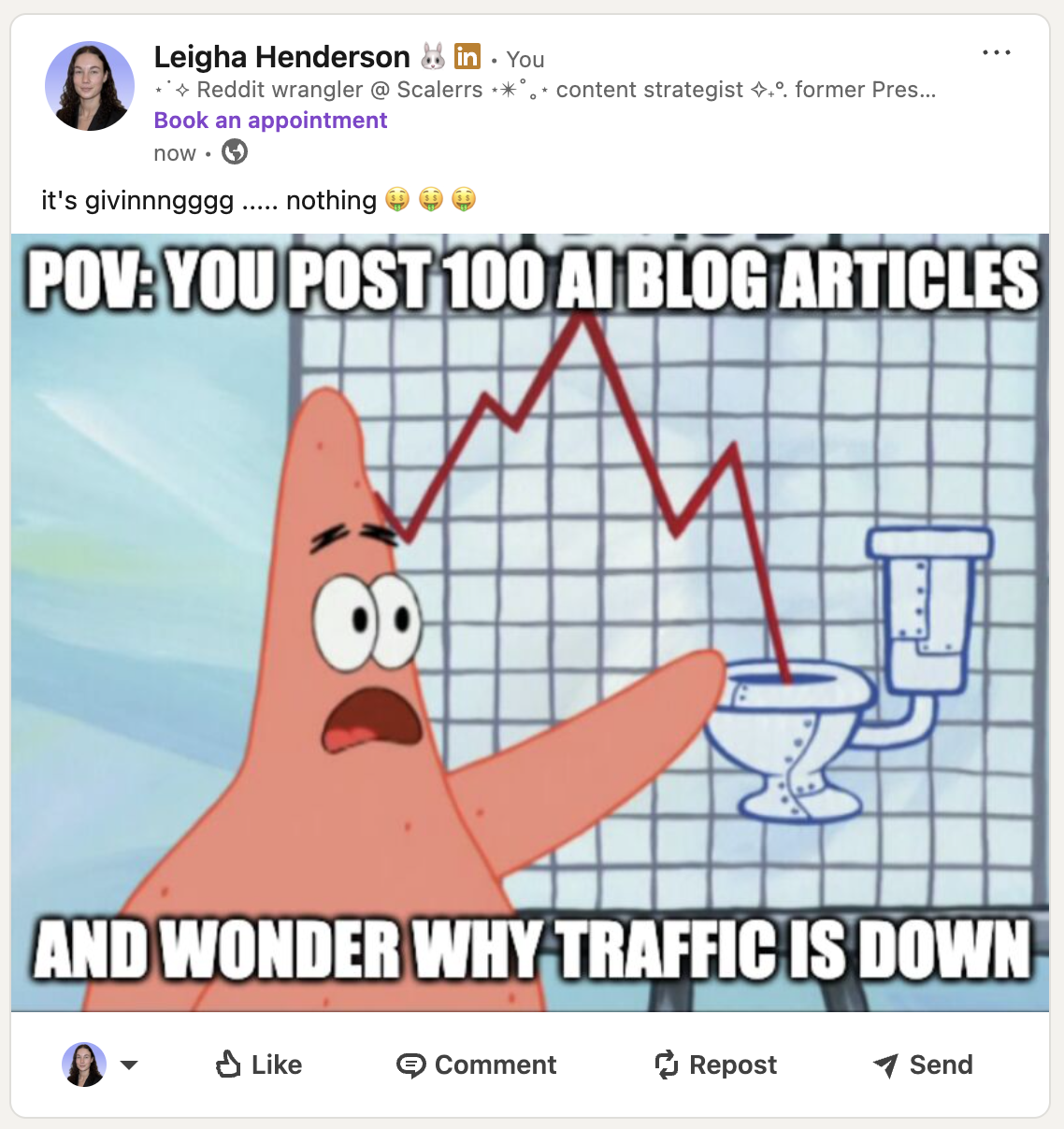
There’s a concept known as the Dead Internet Theory, which suggests that the internet could become completely dominated by AI-generated content and automated interactions. Whether or not that fully materializes is almost beside the point. The feeling behind it is almost here.
You search for something, land on a page, and everything looks right. The structure is clean, the keywords are there, and the answer is technically correct. And yet it leaves you with nothing.
No perspective, no edge, no sense that anyone actually thought about what they were saying. It’s content that exists without meaning, and once you start noticing it, you can’t unsee it.
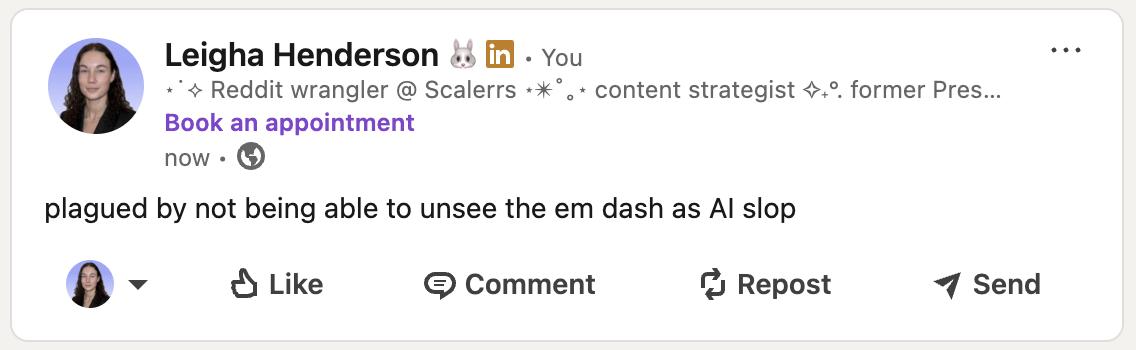
What people are gravitating toward in response is anything that feels unmistakably human. Not necessarily unpolished or chaotic, but grounded in real perspective. Content that reflects experience instead of just summarizing it.
This is where trust becomes the entire game.
When content is easy to produce, people stop valuing its existence and start looking for signals that it actually means something. They look for disagreement and lived experience. They also look for the subtle cues that indicate a real person is behind what they’re reading.
A messy Reddit thread with conflicting opinions often carries more weight than a perfectly polished article. A LinkedIn creator sharing their experiences versus a tool bragging about its features will resonate far more. A creator walking through a product in real time feels more convincing than a polished demo. A random comment with a typo from someone who has actually used the thing can outweigh an entire brand narrative.
People just want to know it’s real people.
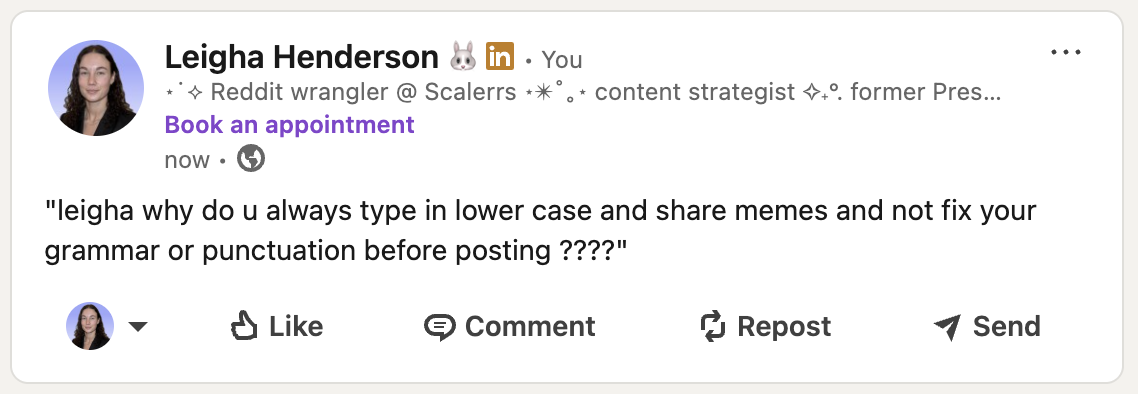
At this point, it’s not just that people prefer this kind of content; humans demand human connection and crave communities that feel alive, messy, and real.
It’s how people connect, validate information, pressure-test claims, and build confidence in their decisions. It’s the difference between being told something is true and watching a group of people collectively arrive at that conclusion (or argue about it, which is often even more useful).
In a world where content is infinite, community is the filter.
This is why community-driven platforms continue to gain influence, and why brands that rely solely on controlled messaging are starting to feel invisible.
“[strategy] is dead” is ultimately just a lazy way of saying that the old playbook doesn’t work like it used to. You can’t rely on keywords and volume alone to win attention or trust. But that doesn’t mean search has disappeared. Clicks haven’t disappeared, or websites. It means the internet has once again expanded into something more complex, more distributed, and much harder to game.
The marketers who understand this are focused on being present in the environments where decisions are actually being made, and contributing something genuinely useful when they get there. They understand that the goal isn’t just to publish content, but to participate in discovery.
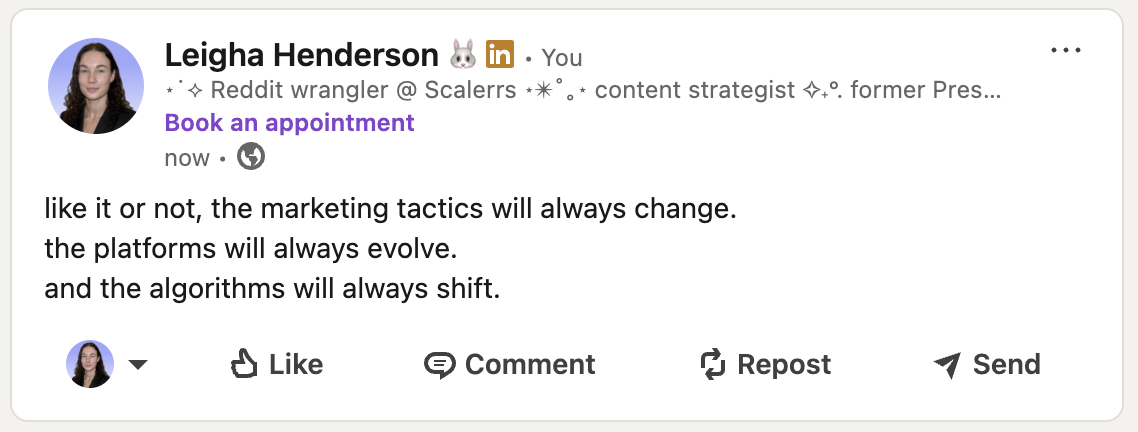
The real human on the other side of the screen does not change.
It becomes harder to fake, harder to control, and more reflective of how people have always made decisions.
And in an environment increasingly shaped by AI, automation, and infinite content, the brands that stand out won’t be the ones that say the most. They’ll be the ones that feel the most real.
Leigha Henderson
Internet User and Marketer at Scalerrs
March 17, 2026
Watching From the AudienceFor a long time, I watched other people on the stage – confident, established, owning their sh*t
The truth most are unaware of I’m going to be honest, and this might sting a little. I’ve worked with
We tend to talk about visibility and personal branding as though it’s superficial – something adjacent to the “real work”